
Factory Diamonds vs Aftermarket Diamonds on Luxury Watches: Resale Value, Identification, and Collector Demand

Quick answer: Factory-set luxury watch diamonds are sourced, calibrated, and set directly by the manufacture (such as Rolex, Patek Philippe, or Cartier) using internally flawless (IF to VVS), color-matched stones and proprietary tolerances. Because factory gem-set pieces maintain full brand authenticity, factory warranties, and strict production limits, they command significant collector premiums and retain 100% or more of their value. By contrast, aftermarket diamond customization involves third-party jewelers drilling into original steel or gold cases, which voids manufacturer warranties and typically reduces the secondary market value of the base watch by 50% to 70% compared to an untouched factory original.
Few topics divide collectors and watch sellers as sharply as diamond customization. Whether you are holding a Rolex Day-Date with a diamond bezel, a Cartier Ballon Bleu or Santos, or a Patek Philippe Nautilus, knowing whether the stones came from Geneva or a local bench jeweler is the single most important factor determining its true cash value. In this expert analysis, the appraisal specialists at Big Watch Buyers break down the craftsmanship divide, the tell-tale physical signs to inspect under a 10x loupe, the manufacturer reference codes that prove factory provenance, and how each configuration is priced on New York’s 47th Street Diamond District in 2026.
Request a Free Diamond Watch Valuation in 15 Minutes
The Craftsmanship Gap: Manufacture Gemology vs. Aftermarket Drilling
To understand why secondary market valuations differ so dramatically, one must examine how factory stones are integrated compared to custom builds.
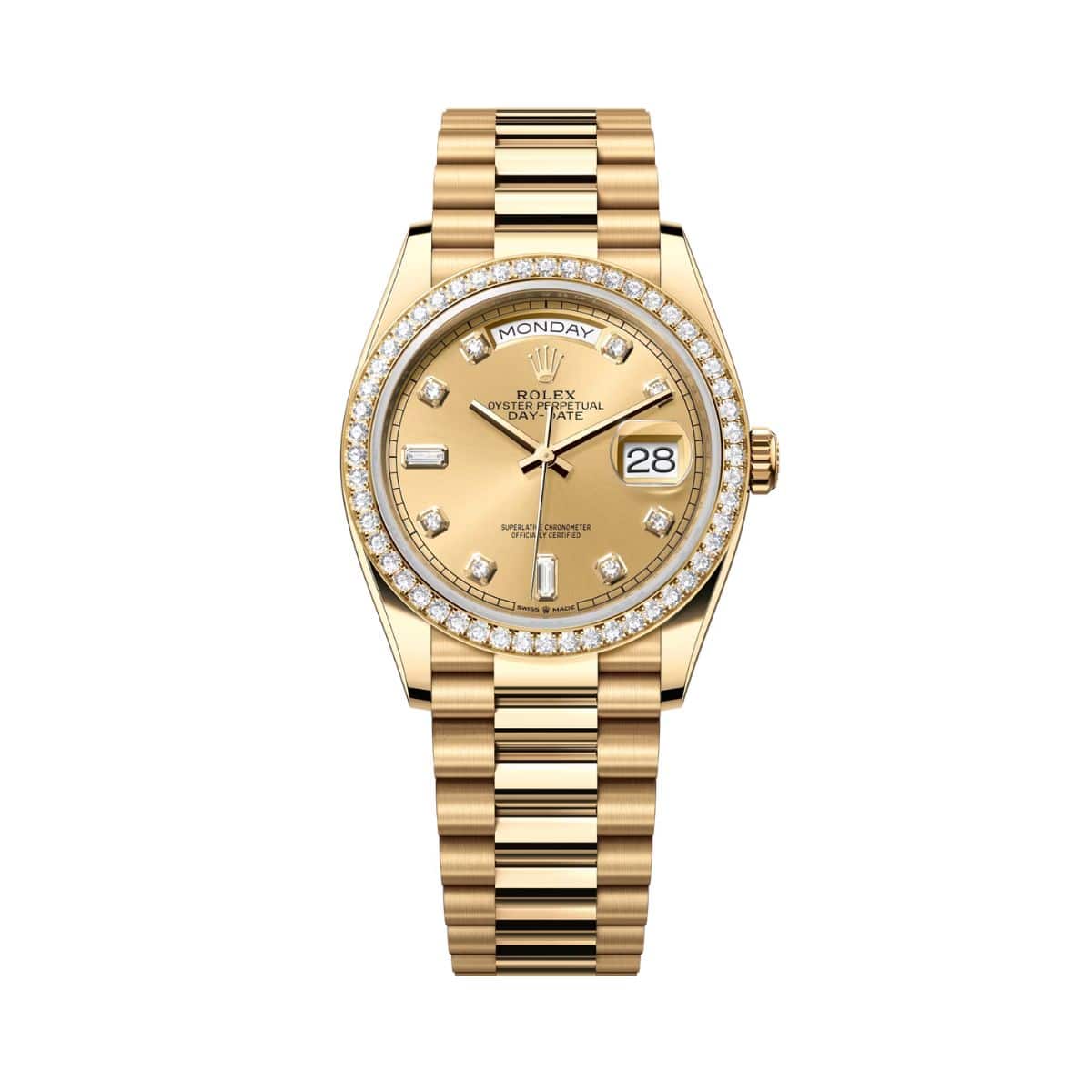
How Rolex, Patek Philippe, and Cartier Select and Set Gems
The gemological departments at elite Swiss manufactures operate under standards that exceed standard retail jewelry guidelines:
- Flawless Sorting: Rolex selects only natural stones within the top color grades (D through G) and clarity levels from IF (Internally Flawless) to VVS. Stones are measured and calibrated to within two hundredths of a millimeter (0.02 mm) so every table, culet, and crown angle reflects light identically.
- Dedicated Metallurgy & Casting: Factory gem-set watch cases and bezels are cast from the outset with dedicated stone seats and prongs engineered into the metal mold. No metal is carved away from a completed watch.
- Water Resistance & Gasket Integrity: Factory gem-set models (such as a Rolex Day-Date 128348RBR or Submariner SABR) maintain complete 100-meter or 300-meter factory depth ratings because bezel seats and crystals are installed under strict cleanroom tolerances.
How Aftermarket Diamond Customization Is Executed
When an untouched watch is customized by a third party, a jeweler takes a standard production watch and modifies it manually:
- Drilling the Metal: The jeweler drills thousands of microscopic holes into the factory case flanks, lugs, bezel, and bracelet links. This removes significant gold or platinum weight on precious metal watches and permanently alters case geometry.
- Lower Stone Quality & Variable Cuts: To manage retail margins, aftermarket builds frequently use SI to I clarity stones, commercial single-cut stones, or lab-grown CVD diamonds that vary noticeably in color, cut grade, and table height.
- Voided Factory Support: Official service centers will refuse to service a modified watch or demand thousands of dollars to restore it to factory specifications. Learn more about how customization impacts resale in our guide to selling an iced out or custom diamond watch.

Key Tell-Tale Signs of Aftermarket Setting (Under a 10x Loupe)
Experienced appraisers can identify aftermarket diamond setting within seconds. When examining a timepiece with a 10x loupe or microscope, our specialists look for four primary physical indicators:
1. Uneven Prong Spacing and Stone Table Heights
On a factory-set Rolex or Cartier, the beads or prongs securing each stone are microscopically identical in dome curvature and spacing. If you run your finger gently across a factory diamond bezel, the surface feels silky and uniform. On aftermarket settings, you will often feel sharp prong edges, notice prongs overlapping stone facets unevenly, or spot stones sitting at slightly differing depths (uneven table planes).
2. Clouded Stones and Color Mismatches
Factory stones appear virtually colorless and internally transparent across the entire bezel or dial. Under UV light inspection, aftermarket diamond bezels frequently exhibit inconsistent fluorescence—some stones glow milky blue while adjacent stones remain dead, indicating a mixed parcel of commercial stones rather than a sorted factory suite.

3. Dial Printing and Font Thickness
When third-party jewelers create aftermarket diamond dials, they either repaint an original brass dial or use an aftermarket blank. Look closely at the coronet, brand typography, and minute tracks: aftermarket dials frequently display slightly blurred pad-printing, incorrect font serif profiles, or misaligned date windows. Read our step-by-step verification standards on our watch authentication page.
4. Bezel Alignment and Outer Perimeter
Factory diamond bezels maintain a razor-sharp, uniform outer metal perimeter that aligns precisely with the crystal gasket. Many aftermarket bezels are cast slightly oversized to accommodate larger stones, which can overhang the case edges or fail a standard dry-pressure vacuum test.

Decoding Factory Reference Suffixes: How Rolex Denotes Factory Gems
The definitive proof of factory gem-setting lies in the model reference number and the official warranty card. Rolex uses a systematic French-derived suffix code to document every factory gem-set watch that leaves Geneva:
- RBR (Rond Brillant): Round brilliant-cut diamonds set on the bezel (e.g., Rolex Day-Date 36 Ref.
128348RBRor Lady-Datejust Ref.279381RBR). - TBR (Trapèze Brillant): Baguette-cut or trapeze-cut diamonds set on the bezel (e.g., Day-Date 40 Ref.
228398TBR). - SARU (Saphirs & Rubis): Blue sapphires, red rubies, and baguette diamonds configured on the bezel (e.g., GMT-Master II Ref.
116759SARU). - SANR (Saphirs Noirs): Black sapphires and baguette diamonds (e.g., GMT-Master II Ref.
116759SANR). - SABR (Saphirs Bleus & Rubis): Blue sapphires and diamonds on bezel and lugs (e.g., Submariner Date Ref.
116659SABR). - TEM (Tailles Émeraude): Emerald-cut diamonds on bezel and lugs.
Crucial Seller Check: If a seller claims a stainless steel Rolex GMT-Master II Ref. 116710LN or Datejust Ref. 16200 is a “factory diamond” piece, that claim is 100% false. Rolex has never produced a factory diamond bezel for stainless steel Submariner or GMT-Master II references; those factory gem-set bezels are reserved exclusively for solid 18k white gold, yellow gold, or platinum cases.

Resale Value and Market Reality: What This Means When You Sell
How do secondary market buyers evaluate both categories when cash offers are on the table?
| Feature | Factory-Set Diamond Watches | Aftermarket Custom Diamond Watches |
|---|---|---|
| Collector Demand | High; global purist collector appeal | Niche; fashion & lifestyle buyers |
| Value Retention | Retains 100%+ of retail or commands strong premiums | Typically drops 50% to 70% from original custom retail cost |
| Manufacturer Service | Fully supported by Rolex, Patek Philippe, and Cartier | Refused or requires costly restoration to factory spec |
| Appraisal Method | Priced by exact reference, provenance, box & papers | Priced by base Swiss watch value + gold weight + diamond CTW |
| Documentation | Warranty card explicitly lists gem-set suffix (e.g., RBR) | Card lists original plain reference without gem codes |
On high-end collector models like a Patek Philippe Nautilus or Aquanaut, aftermarket diamond setting creates an enormous valuation gap. A clean, factory-condition Patek Philippe Nautilus Ref. 5711 or 5980 commands top-tier auction pricing, whereas an example with drilled pavé diamonds suffers a severe penalty among purist collectors. However, a specialized buyer on Manhattan’s 47th Street can still provide an equitable buyout based on the authentic caliber and precious metals.

Selling to Big Watch Buyers: Transparent Dual-Discipline Valuation
Whether you own an investment-grade factory diamond Rolex Day-Date or an aftermarket custom diamond piece, Big Watch Buyers operates with complete transparency:
- For Factory Diamond Owners: We pay premium market prices reflecting full manufacturer originality, rarity, and collector demand. Explore our dedicated brand pages to sell your Rolex watch, sell your Patek Philippe, or sell your Cartier watch.
- For Aftermarket Watch Owners: Unlike traditional watch boutiques that reject custom pieces, or local pawn shops that quote only gold melt scrap, we calculate the real combined value of your genuine Swiss movement, case metal weight, and set diamonds.
- Nationwide & In-Person Service: Meet our appraisers in our private Midtown Manhattan office at 20 W 47th St, Suite 401 (see our NYC Diamond District guide), or ship your watch via complimentary, prepaid FedEx Priority Overnight insured up to $100,000+. Learn how our fully insured shipping works.
Frequently Asked Questions
1. How can I tell if my Rolex has factory diamonds without opening it?
Check your original guarantee card or paperwork. On modern Rolex models, the card will display the full reference with gemological suffix (e.g., 128348RBR or 116595RBOW). On older paperwork, look for the dial code and bezel designation. If the warranty card lists a plain reference (such as 16233 or 116710LN) but the watch has a diamond bezel, the diamonds were added aftermarket.
2. Does adding aftermarket diamonds increase the resale value of my watch?
No. While you may pay several thousand dollars to a retail jeweler for stones and labor, aftermarket customization almost always reduces the resale value of the watch compared to an untouched factory original. The drilling voids factory warranties and eliminates interest from purist collectors.
3. If I have the original factory bezel and dial, does that help my offer?
Yes, significantly. If you had a jeweler install an aftermarket diamond bezel or dial on a Datejust or Day-Date but kept the original factory parts, bring them to the sale. An experienced watchmaker can restore the watch to factory configuration, dramatically increasing its market value.
4. Will Rolex or Cartier service a watch with aftermarket diamonds?
Rolex and Cartier will generally refuse to service any watch containing non-genuine or modified components. In some cases, they will service the watch only if you authorize them to replace all modified parts with new factory originals at full retail cost.
5. How quickly can I get paid for a diamond watch at Big Watch Buyers?
Immediately. Our in-house watchmakers and gemologists complete inspections within 30 to 60 minutes. Once you accept our firm buyout offer, payment is disbursed on the spot via bank wire (Fedwire), cash, or certified company check.
Get an Expert Diamond Watch Appraisal Today
Whether you have an untouched factory gem-set masterpiece or a custom diamond timepiece, you deserve a transparent appraisal from specialists who trade in both fine horology and diamonds. Contact Big Watch Buyers to book a private consultation at our 47th Street office, or submit your watch photos through our free online appraisal form to receive a competitive cash quote today.

About author


Add comment