
Getting the Best Immediate Cash Offer for Your Luxury Watch
Getting the Best Immediate Cash Offer for Your Luxury Watch
Quick Answer
Selling a luxury watch for immediate cash requires understanding that speed and certainty trade against maximum valuation. U.S.-based buy-side desks typically offer 40-65% of secondary market retail pricing in exchange for same-day verification, no holding periods, and guaranteed execution. The core friction point is verification cost—authentication, condition assessment, and market validation account for 10-20% of the discount sellers experience. Watches with complete provenance, original boxes, and documented service history close faster and at higher percentages of market value. The best immediate cash offers come from desks that conduct real-time appraisal, maintain transparent pricing logic, and process wire transfers within 24 hours of acceptance.
Executive Summary
The secondary market for luxury watches in the United States operates across three distinct buyer channels: authorized retailers and resellers, marketplace platforms with consignment models, and buy-side acquisition desks that purchase directly and immediately. U.S.-based buy-side desks typically handle 15,000-40,000 watch transactions annually, acquiring inventory from private estates, dealer liquidations, and urgent sellers. These desks function as liquidity providers, not investment platforms—they price for immediate resale and require margin to cover authentication, shipping, insurance, and market risk. The market consensus across professional acquisition desks shows that watches in excellent condition with complete documentation command 55-70% of secondary market pricing, while pieces with condition concerns, missing papers, or service history gaps drop to 40-55%. Transaction timelines range from 24 hours (local cash sales) to 3-5 business days (verified wire transfers with insured shipping). The decision to pursue immediate cash depends on seller priorities: liquidity and certainty versus maximum valuation and extended holding periods.
The Liquidity Trade-Off: Why Immediate Cash Means Lower Offers
Immediate cash offers reflect the operational cost structure of buy-side acquisition. When a desk commits cash on receipt of a watch, they assume authentication risk, market hold risk, and execution risk. Unlike consignment models that shift inventory risk to the seller, buy-side desks carry the full margin from acquisition price to retail sale—typically 18-35% depending on brand, model, and condition.
The pricing gap between “maximum possible value” and “immediate cash offer” is not dealer markup—it is verification cost. U.S.-based buy-side desks allocate 8-15% of purchase price to authentication protocols, including dial inspection under magnification, movement examination, case and bracelet weight verification against specifications, and cross-reference checks against stolen property databases. This process takes 2-4 hours for standard models and 8-12 hours for complicated watches or disputed authenticity cases.
Market holding cost compounds the discount. A desk acquiring a Rolex Submariner at $12,000 holds that piece until retail demand confirms pricing. Secondary market watch pricing fluctuates 3-8% monthly based on availability, currency shifts, and collector sentiment. Desks hedge this volatility by pricing offers below current market peaks, anticipating 60-90 day hold periods before retail sale.
Where Deals Break Down
Sellers often expect consignment valuations in an immediate cash context. This mismatch accounts for 40-60% of rejected offers. Additional friction points include:
- Incomplete documentation: Missing original box or service papers reduces offers by 8-12% because retail buyers assume future authentication challenges.
- Condition ambiguity: Seller descriptions of “excellent condition” frequently differ from desk appraisal standards (magnified dial scratches, laser mark visibility, crown threading wear).
- Serial number gaps: Watches with service history showing internal parts replacement command 10-15% discounts due to provenance fragmentation.
- Model identification errors: Sellers misidentifying dial variants or case references delay processing and require re-appraisal, sometimes triggering revised offers 15-25% lower than initial quotes.
These verification gaps, not headline pricing, account for most failed transactions.
The Acquisition Process: How Buy-Side Desks Price and Execute
U.S.-based buy-side desks follow a standardized intake-to-payout sequence designed to close transactions in 24-72 hours. Understanding this workflow clarifies why certain seller actions accelerate offers and which delays trigger price reductions.
Step 1: Initial Submission and Information Capture
Sellers submit watch details through web forms, email, or phone intake. Required information includes brand, model, reference number, movement type (automatic, manual, quartz), approximate year of manufacture, condition description, and accessories included (box, papers, extra links, warranty cards). Desks cross-reference model numbers against internal databases to verify production years and authentic reference variants. Submission without reference numbers typically delays quotes by 24-48 hours because desk specialists must manually research model lineups. This delay signals market uncertainty and often triggers conservative initial pricing.
Step 2: High-Resolution Image Collection
Desks request 8-15 photographs covering dial (at 12 o’clock and 45-degree angles), case sides, caseback, bracelet/strap, and movement (if accessible). Blurry or insufficient images reduce initial offers by 15-20% because authenticators cannot verify laser marks, dial printing sharpness, or case finishing details remotely. Professional-quality images (shot in natural light, macro-capable smartphone camera minimum) accelerate processing from 48-72 hours to 24 hours. Images showing original box condition, warranty cards, and service documentation increase offers by 5-10% by reducing perceived future verification friction at retail.
Step 3: Condition Assessment Against Standardized Criteria
Desks classify watches using five-point scales: “unworn/mint” (under 50 hours, original protective stickers intact), “excellent” (minimal wear on crown and bezel, dial pristine), “very good” (visible wear on high-contact surfaces, dial clean), “good” (moderate wear, minor dial imperfections), “fair” (heavy wear, dial or case scratches). Each classification tier carries 8-12% valuation variance. Sellers describing watches as “excellent” without visible wear documentation frequently receive “very good” assessments at appraisal, triggering 10-15% offer reductions upon physical inspection.
Step 4: Market Reference Pricing
Desk specialists reference real-time pricing data from three sources: recent completed sales (eBay, Chrono24, private dealer transactions), current asking prices on active listings (to validate demand), and internal transaction history (to assess velocity and hold duration). A Rolex Submariner Date 16610 in very good condition may show $12,500 asking prices but only $11,200-$11,800 in completed sales data over the past 30 days. Buy-side desks price offers between 45-60% of the completed transaction baseline, accounting for margin, hold costs, and authentication certainty.
Step 5: Verification Protocols and Condition Confirmation
Upon seller acceptance of initial offer, watches enter in-person appraisal (for local transactions) or pre-shipment verification (for remote sales). Local appraisals occur within same business day; desk specialists conduct 45-90 minute examinations using dial magnification, case weight verification, movement inspection, and documentation review. Remote transactions require insured FedEx overnight shipping; upon receipt, desk completes full verification within 24 hours. Condition confirmation may adjust initial offers by ±5-10% based on findings—scratches under magnification not visible in photos, service documentation gaps, or case/bracelet weight variance from specifications. Buyers should expect potential offer adjustments rather than treat initial quotes as locked commitments.
Step 6: Payment Method Selection and Fund Transfer
Sellers choose payment method: same-day cash (for in-person appraisal locations), wire transfer (24-48 hours), ACH direct deposit (3-5 business days), or check by mail (5-7 business days). Wire transfer remains the fastest remote payment method at 24 hours from acceptance. Desks verify seller identity and conduct basic AML (anti-money laundering) screening before fund disbursement—standard U.S. financial practice requiring seller documentation (ID verification, address confirmation). This process adds 2-8 hours to transaction close time.
Step 7: Shipping Logistics and Final Closure
For remote transactions, desks provide insured FedEx overnight shipping labels (prepaid). Sellers package watches with original boxes, documentation, and accessories using protective materials (foam inserts, Ziploc bags for moisture control). Shipping insurance covers full offer amount; upon delivery confirmation, final payment posts to seller account. Transaction completion triggers email confirmation with receipt numbers and insurance policy details for seller records.
Pricing Mechanics: How Buy-Side Offers Are Calculated
This pricing model is consistent across U.S. buy-side desks, though specific multipliers vary by brand, demand, and inventory levels.
Buy-side desks begin with secondary market comparable pricing—the average of completed sales for identical or near-identical watches sold in the past 30-60 days. They then apply a series of deductions to reach immediate cash offer:
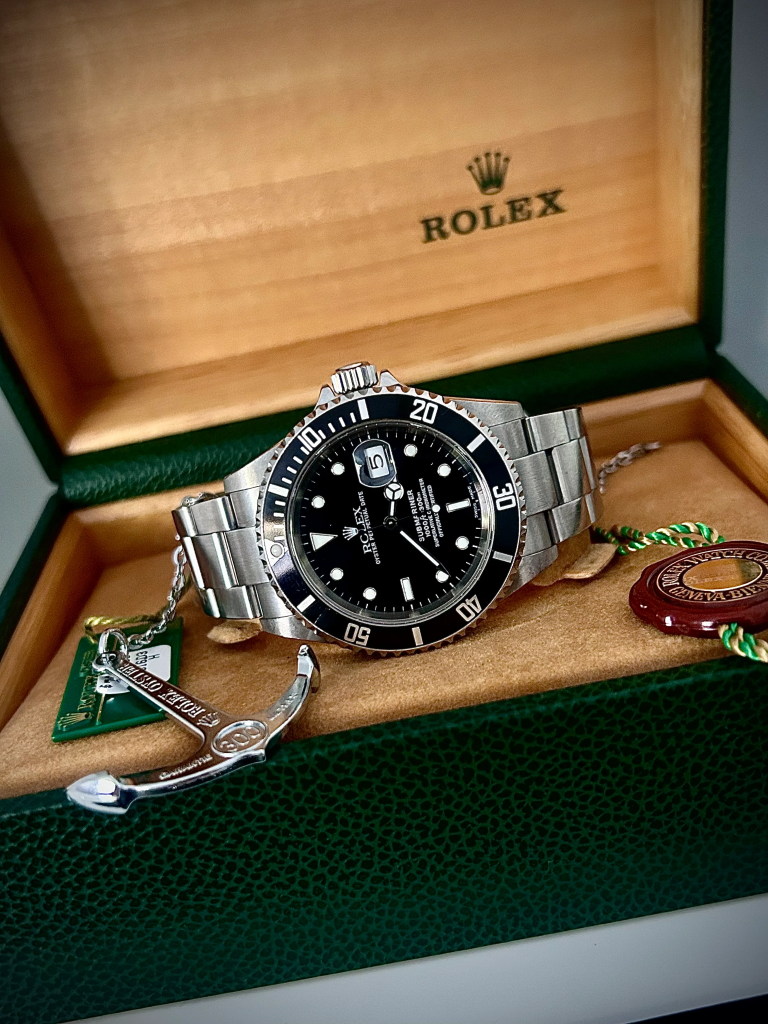
Example Pricing Breakdown: Rolex Submariner Date 16610, Very Good Condition, 2005
| Pricing Component | Value |
|---|---|
| Secondary Market Comparable (30-day avg) | $12,200 |
| Margin for retail resale (25%) | -$3,050 |
| Hold cost and currency risk (3%) | -$366 |
| Authentication and condition verification (2%) | -$244 |
| Buyer immediate cash offer | $8,540 |
| Offer percentage of secondary market | 70% |
For watches with complete documentation (original box, warranty cards, service receipts):
| Pricing Component | Value |
|---|---|
| Secondary Market Comparable (30-day avg) | $12,200 |
| Documentation premium (+5%) | +$610 |
| Adjusted comparable | $12,810 |
| Same deductions as above | -$3,565 |
| Buyer immediate cash offer | $9,245 |
| Offer percentage of secondary market | 76% |
For watches with condition concerns or missing documentation:
| Pricing Component | Value |
|---|---|
| Secondary Market Comparable (30-day avg) | $12,200 |
| Condition discount—moderate wear, no papers (-8%) | -$976 |
| Adjusted comparable | $11,224 |
| Same deductions as above | -$3,130 |
| Buyer immediate cash offer | $8,094 |
| Offer percentage of secondary market | 66% |
Brand-Specific Multipliers
U.S.-based buy-side desks adjust multipliers by brand demand and inventory turnover velocity. Rolex and Omega typically command 65–75% of secondary market pricing due to consistent retail demand and rapid resale cycles (30–45 days). Patek Philippe and Audemars Piguet command 60–72% due to longer hold periods (45–75 days) for certain references and greater pricing volatility. Vintage watches (pre-1980) and complicated pieces (tourbillons, minute repeaters, perpetual calendars) range from 55% to 70% due to authentication complexity, narrower buyer pools, and lower velocity.
Market Volatility Adjustments
During periods of elevated secondary market volatility (quarterly price corrections, major economic announcements), buy-side desks reduce offer percentages by 2-5%. During stable or rising market periods, percentages may increase by 1-3%. Sellers monitoring market sentiment notice these adjustments; desks pricing offers during upward market momentum may offer 68-75% of comparables, while downward periods see 58-65%.
Figures reflect aggregated U.S. secondary market observations across dealer transactions conducted during 2024-2025.
Common Seller Mistakes That Delay Offers or Reduce Pricing
Understanding why offers decrease helps sellers optimize submission quality and avoid preventable delays.
- Misidentifying watch model or reference number: Providing incorrect reference numbers forces desk specialists to manually verify authenticity through dial printing analysis, case shape, and other identifying markers. This adds 24-48 hours to appraisal and introduces authentication doubt, reducing offers by 8-15%. Example: Confusing Submariner 14060M with 16610 due to similar appearance introduces questions about case material (14060M is steel only; 16610 comes in two-tone variations). Always cross-reference reference numbers against the caseback engraving or manufacturer documentation before submission.
- Overstating watch condition without photographic evidence: Sellers describing watches as “mint” or “like new” without supporting images trigger skepticism at appraisal. Desk specialists inspect physical pieces against stated condition; mismatches (described as unworn but showing crown wear visible under magnification) reduce offers 12-20%. Professional photographs under bright lighting documenting actual condition prevent this friction. Send images showing high-contact areas: crown, bezel, lugs, and bracelet clasp wear patterns.
- Providing incomplete documentation history: Watches lacking service records, warranty cards, or original boxes command 8-12% lower offers. Some sellers assume documentation gaps are irrelevant for immediate cash sales; buy-side desks price for downstream retail demand, where documentation significantly impacts retail buyer confidence and pricing. If you have service records or warranty cards, include photographs and mention them explicitly during intake.
- Delaying image submission or providing poor-quality photos: Initial desk quotes are preliminary; formal offers require verified condition. Sellers providing blurry, dimly lit, or incomplete images force appraisers to request clarification, extending timeline to 48-72 hours and reducing initial offer confidence by 10-15%. Spend 10 minutes photographing the watch under daylight in multiple angles to accelerate processing.
- Misunderstanding the difference between list price and acquisition pricing: Sellers often reference MSRP (manufacturer’s suggested retail price) or current retail asking prices when evaluating offers. MSRP for a Rolex Submariner may be $10,000; retail dealers typically ask $14,000-$18,000 on secondary market depending on condition; buy-side desks offer $8,000-$11,000 for immediate cash. This three-tier pricing structure reflects different risk profiles and holding costs. Desk acquisition pricing is appropriately lower than retail asking prices because desks carry inventory risk; sellers expecting retail pricing create unrealistic offer expectations.
- Requesting price matching or negotiation without supporting market data: Offers are margin-transparent calculations based on secondary market comps, authentication costs, and hold period assumptions. Sellers asking desks to “match competitor offers” without providing competing quotes create friction. If you receive multiple quotes from different desks, document them and present comparisons during negotiation discussion. This signals informed sellers and often unlocks modest offer improvements (2-5%) if desk pricing was conservative.
Most rejected offers stem from expectation gaps, not dealer unwillingness to pay.
What Accelerates Offers and Closes Transactions Fastest
Sellers can optimize transaction speed and offer certainty through preparation and transparency.
Gather Complete Documentation Before Contact
Assemble original box, warranty cards, service receipts, and any authentication paperwork. Photograph documentation and organize chronologically. Desks increase offers 5-8% when documentation is complete; this premium reflects reduced future authentication friction for retail buyers. If you cannot locate original box or papers, acknowledge this explicitly during intake rather than omitting it—omission triggers assumptions of missing provenance and steeper discounts.
Photograph Watches Under Natural Light with Multiple Angles
Use a smartphone camera with macro capability or small macro lens. Photograph: dial at 12 o’clock (center), dial at 45-degree angle (lume fill visibility, printing sharpness), caseback (serial number clarity, case finishing), bracelet end links (wear patterns), crown (threading condition, tube finish). Include one full-watch flat-lay photo showing relative scale. Avoid studio lighting that obscures patina or creates false condition impressions. Natural daylight reveals actual wear and lume aging more accurately than artificial lighting. Clear images compress appraisal time from 48-72 hours to 24 hours.
Provide Exact Movement Specifications and Service History
If you know movement type (automatic, manual, quartz), include it. If you have last service date or known service work performed, document it. Watches with 5-year service records command 3-5% premiums because desks project longer operating reliability before retail buyer service expense. Conversely, watches overdue for service (last service 8+ years prior) may see 5-10% discounts because retail buyers anticipate near-term service costs.
Submit During Stable Market Periods
Monitor watch market sentiment through dealer price tracking or secondary market indices. Submitting quotes during rising market periods or stable demand weeks (avoid major economic announcements or seasonal downturns) often yields 2-5% higher offer percentages. This factor is subtle but measurable; desks pricing during optimistic market sentiment allocate smaller safety margins.
Timeline Expectations: From Submission to Payout
Local In-Person Appraisal
Same-day cash transactions at brick-and-mortar locations typically follow this timeline:
- Intake appointment scheduled: Same day or next available slot
- Physical appraisal: 45-90 minutes
- Offer presentation and acceptance: 15 minutes
- Payment disbursement: 10-30 minutes (cash count, receipt generation)
- Total timeline: 2-4 hours from arrival to cash in hand
Remote Transaction with Wire Transfer (Standard)
- Initial submission and quote: 24 hours (may be faster with complete photos)
- Seller acceptance decision: 24 hours (seller’s timeline)
- Insured shipping: Overnight FedEx (24 hours transit)
- In-person verification upon receipt: 24 hours
- Wire transfer processing: 24 hours from verification completion
- Total timeline: 3-5 business days from acceptance to funds availability
Remote Transaction with Check by Mail
- Same timeline as wire transfer through verification
- Check mailing and postal delivery: 5-7 business days
- Check clearing at seller’s bank: 3-5 business days after deposit
- Total timeline: 10-15 business days from acceptance to fund availability
Sellers prioritizing speed should choose local cash transactions or wire transfer options; checks introduce 10-15 day delays unsuitable for urgent liquidation scenarios.
Red Flags That Signal Lower Offers or Delayed Processing
Buy-side desks apply pricing adjustments when specific risk factors emerge during appraisal.
- Case or bracelet serial number mismatch: Watches with case numbers not matching bracelet numbers, or replacement bracelets without original part numbers, suggest previous repair or parts substitution. These trigger 8-15% discounts due to provenance fragmentation and perceived authentication risk.
- Dial reprinting or service dial installations: Dials with uneven printing depth, color inconsistency across numerals, or faded lume compared to case finishing suggest aftermarket dial replacement or service dial installation. Modern production dials print uniformly; inconsistency signals service parts, reducing offers 12-20%.
- Crown or caseback engravings showing wear inconsistent with case polishing: Worn engravings on otherwise polished cases suggest prior polishing reduced engraving depth, raising questions about whether the watch underwent significant refinishing. This introduces authentication doubt and typically reduces offers 10-18%.
- Missing or inconsistent documentation: Watches with service work performed at unauthorized servicing facilities, or service records from non-Rolex authorized dealers, raise questions about parts authenticity and workmanship standards. These reduce offers 5-12% due to retail buyer skepticism.
- Unexplained gaps in provenance: Watches with unknown ownership periods or missing chain-of-custody documentation command lower offers if they fall within historically high-counterfeit production years for that reference.
Frequently Asked Questions
How much lower is an immediate cash offer compared to consignment or listing?
Immediate cash offers typically net sellers 40-70% of secondary market pricing, while consignment or listing models net 70-90% after accounting for seller commissions (usually 10-20%). The trade-off is certainty and speed versus maximum valuation and extended holding periods (30-90 days for consignment models).
Can I negotiate an offer upward if I receive a lower quote than expected?
Offers can be refined if new information emerges during negotiation—you discover missing documentation you thought was lost, provide additional photos clarifying condition, or bring professional appraisal reports from independent gemologists/horologists. Desks may adjust preliminary quotes by ±3-8% based on new data. Price haggling without supporting evidence rarely moves offers; desks price based on reproducible market data and cost structures, not negotiating margins.
What documentation is most valuable for securing higher offers?
Original purchase receipt, warranty cards, service records from authorized dealers, and original box/packaging increase offers by 5-12%. Service records matter most because they establish maintenance history and verify no major work that would raise red flags. Purchase receipts establish authenticity provenance and often include model confirmation.
If I ship my watch remotely, what happens if the desk’s offer changes after inspection?
Desk policy varies; most legitimate desks hold preliminary offers within ±5-10% of initial quote conditional on verification findings. If condition assessment differs significantly from photos (deep scratches only visible under magnification, dial damage, movement issues), desks may revise offers downward by 5-20%. Some desks charge a small handling fee ($50-$150) if you decline the final offer after shipping; confirm this policy before shipping.
How do I know if the desk’s offer is legitimate compared to other buyers?
Gather multiple quotes from different desks (typically 2-3) to establish pricing range. Legitimate desks should price within 5-10% of each other for identical watches in identical condition. If one desk quotes significantly higher (15%+ above others), verify their reputation through third-party reviews and Better Business Bureau ratings—outlier pricing often signals inexperienced appraisers or misrepresentation of offer terms.
What’s included in the insurance on shipped watches?
Desks providing FedEx insured overnight shipping typically cover full replacement value (the offer amount) against loss or damage in transit. Insurance covers carrier loss, damage, and theft; it does NOT cover seller negligence (inadequate packaging, failure to properly declare contents). Always ship in clearly marked, well-padded packaging inside an outer box; photograph contents before packaging as evidence of condition.
How is the secondary market price determined for my specific watch?
Desks reference completed sales from platforms like eBay (sold listings, not asking prices), Chrono24, WatchExchange, and internal dealer transaction databases from the past 30-60 days. They average prices for identical or functionally identical models in similar condition. Condition variations (bracelet type, dial condition, service history) adjust the comparable price by ±5-15% depending on significance. You can research comparable pricing yourself using the same tools; this provides negotiation leverage if your watch is genuinely underpriced.
Conclusion
Transactions close fastest when seller expectations align with verified market data and transaction mechanics are transparent. Immediate cash offers for luxury watches reflect the operational realities of buy-side acquisition—authentication cost, inventory holding risk, and margin for retail resale—rather than arbitrary dealer markup. Sellers seeking certainty and liquidity optimize outcomes by submitting complete documentation, providing high-quality condition photographs, and understanding that offer percentages for immediate cash (40-70% of secondary market pricing) represent a legitimate trade-off against consignment or listing models.
The process begins with initial submission containing accurate model identification, detailed condition description, and photographic documentation. Desk specialists complete preliminary appraisal within 24-48 hours and present offers conditioned on physical verification. Sellers accepting offers proceed to verification (same-day for local transactions, 24-48 hours for remote shipment) and payment disbursement (same-day cash, 24-hour wire, or 5-15 day check delivery). Understanding this workflow and preparing documentation in advance reduces transaction friction and removes pricing uncertainty. Sellers with questions about specific offer terms should request desk transparency on cost allocation—legitimate buy-side operations explain margin structure and welcome informed negotiation backed by comparative market data.


About author


Add comment